This guide breaks down every real cost in the chain between our factory floor in Shenzhen and a repair shop or warehouse in the UK, Germany, Australia, or the US. I'll use iPhone 11 Incell screens at a 200-unit order volume as the working example throughout, but the structure applies to any model and any volume tier.
Why the quote price is just the starting point?
Let's say you receive three quotes for iPhone 11 Incell screens:
- Supplier A: $16.50 per unit, EXW Shenzhen
- Supplier B: $18.00 per unit, FOB Shenzhen
- Supplier C: $22.00 per unit, DDP your warehouse
Most buyers look at this and assume Supplier A is cheapest. Often they're wrong. Here's why.
EXW (Ex Works) - what it actually means?
EXW means the price covers the screens sitting in the supplier's warehouse, ready for collection. Everything else is your cost and your responsibility: domestic trucking to the port or airport, export customs declaration, freight forwarding fees, international shipping, import duties, VAT on import, and final delivery to your address.
For a 200-unit order of iPhone 11 screens, here's what those additional costs typically look like for a buyer in the UK:
- Domestic China trucking to Shenzhen airport or port: approximately $40–60 for a small carton via a freight forwarder. Some suppliers include this in practice even when quoting EXW; others genuinely don't - confirm in writing.
- Export customs clearance and documentation: $35–60 per shipment. This includes the export declaration filing and any relevant certificates of origin. Your freight forwarder handles this but charges for it.
- International air freight (Shenzhen to UK, roughly 3–5kg for 200 screens): $180–320 depending on carrier, route, and current fuel surcharges. Air freight rates have been volatile since 2022 and are not what they were pre-pandemic. Get a live quote from your forwarder, not a ballpark from the supplier.
- UK import duty on mobile phone parts: currently 0% under HS code 8517.70 for most LCD components from China. However, confirm this with your customs broker before assuming - classification errors are common and the liability sits with the importer, not the supplier.
- UK import VAT (20%): This applies to the customs value, which is the CIF value (cost + insurance + freight). On a $3,300 shipment with $250 freight, that's VAT on roughly $3,550 - approximately $710. You reclaim this on your VAT return if you're VAT-registered, but it's a cash flow cost in the meantime.
Final courier delivery: If the shipment arrives at a UK bonded warehouse or port, add $20–40 for final delivery.
Total additional costs on top of EXW for 200 units to UK: approximately $985–1,210, which works out to roughly $4.90–6.05 per screen on top of the quoted EXW unit price.
So Supplier A's $16.50 EXW becomes approximately $21.40–22.55 landed. Supplier C's $22.00 DDP is suddenly competitive - and comes with none of the logistics headaches.
FOB (Free On Board) - the most common trade term for this category
FOB means the supplier covers the cost of getting the goods onto the vessel or aircraft at the named port of shipment - in practice, this usually means they cover domestic China trucking and export clearance. You pay for international freight onwards.
For most repeat wholesale buyers who have an established freight forwarder relationship, FOB is the practical sweet spot. You control the freight leg - which means you control the carrier choice, the transit time, and the insurance - while the supplier handles the China-side export process.
What to confirm when a supplier quotes FOB:
- Is it FOB airport (air) or FOB seaport? These are different costs and timelines.
- Does it include export customs documentation, or just the domestic trucking?
- What's the cutoff for order placement to hit a specific week's consolidation?
For a 200-unit order, the difference between air freight (5–7 days transit, $200–320) and sea freight (25–35 days, $60–90 for a small LCL consolidation) is significant on the timeline but relatively small on the per-unit cost - roughly $0.70–1.30 per screen difference. Most repair parts buyers ship by air because the working capital tied up in 30 days of transit inventory costs more than the freight saving.
DDP (Delivered Duty Paid) - convenience at a price, but sometimes the right choice
DDP means the supplier handles everything: export, international freight, import duty, and delivery to your named address. The price is all-in. You receive a box.
The convenience premium is real but quantifiable. Most suppliers offering DDP are using consolidation couriers - DHL, FedEx, or UPS - and have negotiated volume rates that are better than what a small buyer would pay independently. For orders under 100 units, DDP pricing is often genuinely competitive on a landed-cost basis.
The risk with DDP is customs valuation. Some suppliers using DDP will undervalue the shipment on the commercial invoice to reduce your import VAT exposure. This is both illegal and your liability as the importer - not the supplier's - even though you didn't request it. If you're a VAT-registered business, undervaluation causes more problems than it solves: mismatched paperwork, VAT reclaim complications, and potential HMRC flags. Ask any DDP supplier explicitly: "Do you declare the full invoice value on the customs documentation?" A reputable supplier will confirm yes without hesitation.
The hidden cost that none of the trade terms cover: returns
One cost that appears on no quote sheet and in no Incoterms discussion is the cost of defective units requiring return to China.
For a 200-unit order with a 3% defect rate - which is realistic for standard aftermarket TFT - you're dealing with six defective screens. The options are:
- Return to supplier for replacement: Cost to you includes international return shipping (typically $15–25 for a small parcel), packaging, and the time lag before replacements arrive. On a per-unit basis that's $2.50–4.20 in shipping cost alone before you account for staff time.
- Credit on next order: Most established suppliers will offer credit rather than physical return for small quantities. This is almost always the more cost-efficient resolution - take the credit if it's offered.
- Absorb locally: If the defect rate is low and the per-unit cost of return shipping exceeds the unit value, absorbing the occasional defective unit and claiming credit is standard practice. Build this into your initial pricing negotiation rather than treating it as an exception.
The practical implication: a supplier with a 1.5% defect rate and a $1.50 higher unit price will almost always be cheaper on a total-cost basis than a supplier with a 4% defect rate and a lower headline price. Run the numbers for your own volume before defaulting to the lowest quote.
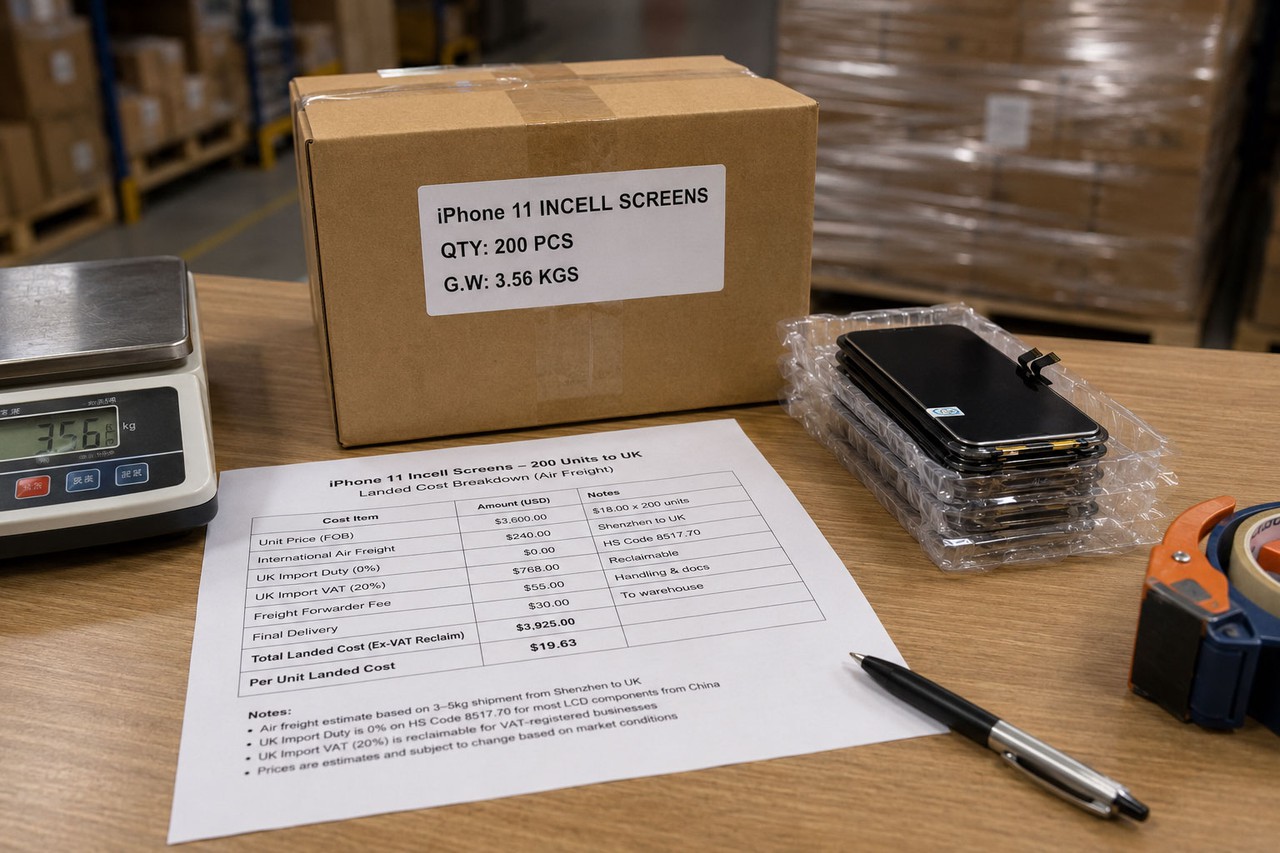
What a realistic landed cost looks like - worked example
Order: 200 units iPhone 11 Incell, UK buyer, air freight
| Cost item | Amount |
|---|---|
| Unit price (FOB, Supplier B) | $18.00 × 200 = $3,600 |
| International air freight | $240 |
| UK import duty (0% on HS 8517.70) | $0 |
| UK import VAT (20%, reclaimed) | ~$768 cash flow |
| Freight forwarder handling fee | $55 |
| Final delivery | $30 |
| Total landed cost (ex-VAT reclaim) | $3,925 |
| Per unit landed | $19.63 |
Compare this to Supplier A at $16.50 EXW: add $5.40 in average logistics costs and you're at $21.90 per unit landed - $2.27 more per unit than Supplier B's FOB price, despite appearing cheaper on the quote sheet.
Practical recommendations
Start with FOB pricing and your own freight forwarder once your order volume exceeds 100 units per shipment. Below that threshold, DDP couriers are often genuinely cost-competitive and significantly simpler.
Always get a freight quote from your forwarder before finalising a purchase order, not after. Freight rates move, and locking yourself into an order at EXW without a current freight quote is where budget overruns happen.
Build a 2–3% defect allowance into your cost model. It's not pessimism - it's accurate cost accounting.
If you're ordering from a new supplier for the first time, EXW or FOB is safer than DDP purely from a customs documentation transparency standpoint. You control the paperwork trail.